

Table of Contents
- How to Use This List
- List of Essential Oils A to Z
- A
- B
- C
- 20. Cajeput
- 21. Camphor (White)
- 22. Caraway
- 23. Cardamom
- 24. Carrot Seed
- 25. Cassia
- 26. Catnip
- 27. Cedarwood, Atlas
- 28. Cedarwood, Himalayan
- 29. Cedarwood, Texas
- 30. Cedarwood, Virginian
- 31. Celery Seed
- 32. Chamomile, German
- 33. Chamomile, Roman
- 34. Cilantro
- 35. Cinnamon Bark
- 36. Cinnamon Leaf
- 37. Cistus
- 38. Citronella
- 39. Clary Sage
- 40. Clementine
- 41. Clove Bud
- 42. Coffee
- 43. Cognac
- 44. Copaiba
- 45. Coriander Seed
- 46. Cumin
- 47. Cypress
- D
- E
- F
- G
- H
- J
- K
- L
- M
- N
- O
- P
- R
- S
- T
- V
- W
- Y
- Essential Oils I Never Use
- General Essential Oil Safety Precautions
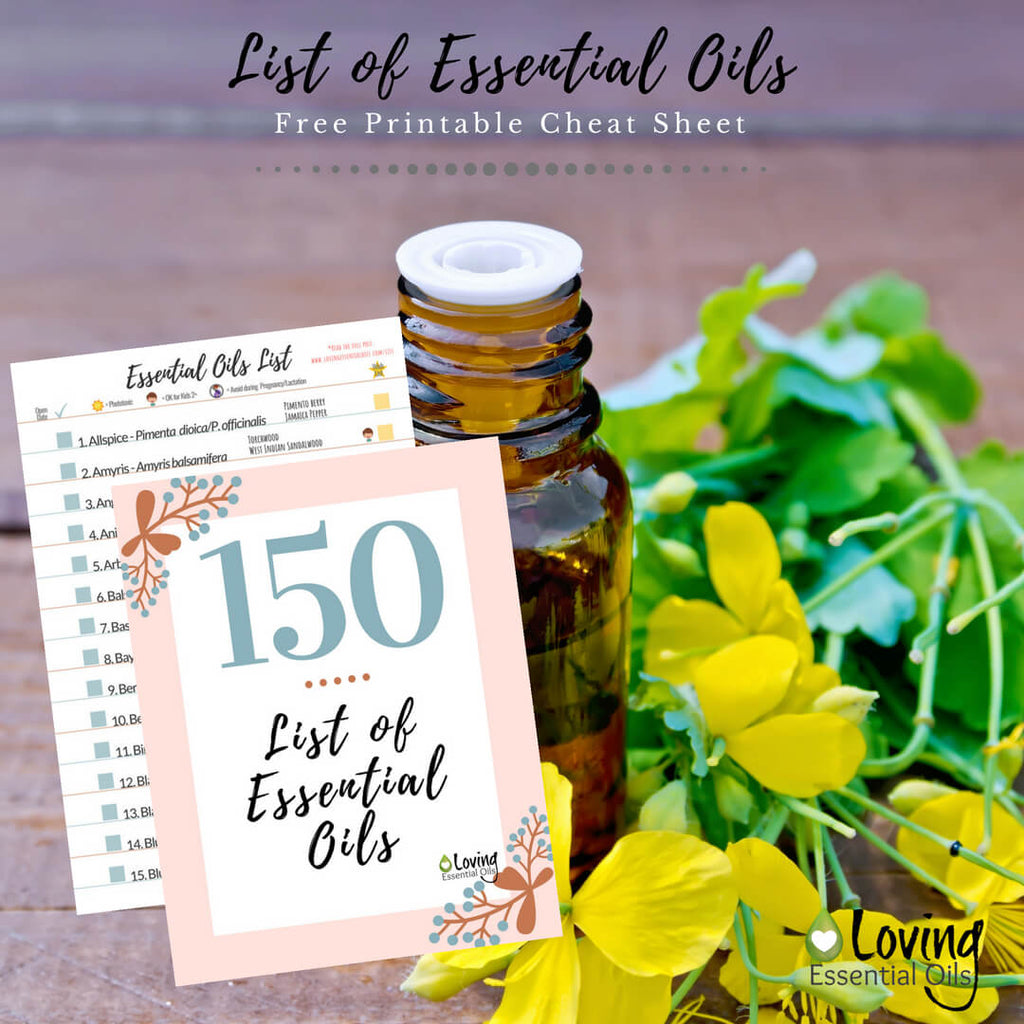
- Free Printable List of Essential Oils
- FAQs
Updated November 2026
This is my A to Z list of essential oils: 150 oils with each one's botanical name, what it smells like, how people use it, the minimum age, and the safety notes you need to know. New to oils? Start with the 15 beginner favorites below, then explore the full list or download the free printable PDF.
I'm a Certified Aromatherapist, and I don't recommend one brand over another. Instead, I share what to look for in a quality oil, so you can use this list with whatever brand you have on hand. Brands sometimes name oils differently, so always check the botanical (Latin) name on your bottle.
New to essential oils? Start with these 15
Lavender, Peppermint, Lemon, Sweet Orange, Tea Tree, Eucalyptus Radiata, Frankincense, Cedarwood, Virginian, Rosemary, Roman Chamomile, Bergamot FCF, Geranium, Grapefruit, Ylang Ylang, Copaiba.
How to Use This List
Each oil includes its botanical name, a short description of its scent and how people like to use it, the minimum age, any safety notes, and a link to my full guide when I have one. Look for these tags:
- 📖 Book Profile: Featured in my upcoming essential oils book, with a full profile.
- 🤰 Avoid in Pregnancy: Skip during pregnancy (and usually breastfeeding).
- ☀️ Photosensitive: Can cause a sun reaction on skin. Diffusing is fine.
- 🧒 Caution: Young Kids: Can slow a young child's breathing or affect the nervous system. Keep it away from young children's faces, and follow the Ages line for diffusing too.
- ⚠️ High-Risk Oil: Read the safety notes before using.
About ages: No essential oils at all for babies under 2, including diffusing. Kids 2 to 4 use only my six starter oils (marked Ages 2+) at 0.5%, after checking with your pediatrician. Kids 5 to 11 can use oils marked Ages 5+ at 0.5 to 1%. Some oils wait longer, and the Ages line on each oil tells you when. Ages apply to diffusing and inhalers too.
About pregnancy: The 🤰 tag marks oils to avoid, but an oil without the tag isn't automatically safe during pregnancy. My pregnancy list has my favorites. Check with your doctor or midwife.
About dilution: Max dilutions are a ceiling, not a target, and are for adults. The limits come from Tisserand and Young's Essential Oil Safety, except valerian, marked "my limit," where I'm more cautious and say why. If an oil shows no max, it has no special limit, so follow my dilution chart. My maximum dilution list has the oils that need lower limits. For everyday adult use, 2 to 3% is plenty. Use fresh oils too, since old, oxidized oil is more likely to irritate skin. See my dilution guide and essential oil safety tips.
List of Essential Oils A to Z
Jump to a letter: A · B · C · D · E · F · G · H · J · K · L · M · N · O · P · R · S · T · V · W · Y · Oils I Never Use
A
1. Agarwood
Aquilaria crassna
Imagine an old library, a temple, and a campfire all at once. Agarwood (oud) is one of the most expensive oils in the world, so most people meet it in a perfume first. A single drop in a meditation blend is plenty.
Ages: 12+
Read the full Agarwood guide →
2. Allspice
Pimenta dioica
Allspice smells like clove, cinnamon, and nutmeg rolled into one, which is how it got its name. It's a single oil from one dried berry, not a blend. Pair a drop with sweet orange on a chilly fall afternoon and your kitchen will smell like a bakery.
Ages: 12+ · Max dilution: Diffuse only (0.15% on skin) · Safety: Strong skin irritant. May affect blood clotting.
Read the full Allspice guide →
3. Amyris
Amyris balsamifera
Sometimes sold as West Indian sandalwood, though it isn't a true sandalwood at all. It's soft and woody with a hint of vanilla, costs a fraction of the real thing, and makes a handy stand-in for sandalwood in bedtime and meditation blends.
Ages: 5+
4. Angelica Root
Angelica archangelica
Earthy, musky, and a little peppery. Angelica root has a heavy, grounding scent, so 1 drop anchors a blend nicely. It's one of the few root oils that can make skin sun-sensitive.
Ages: 12+ · Safety: Phototoxic; keep under 0.8% on skin that will see the sun.
Read the full Angelica Root guide →
5. Anise
Pimpinella anisum
If you like black licorice, you'll recognize this one instantly. It comes from the same little seeds used in biscotti, and a drop goes a long way in a cozy diffuser blend.
Ages: 12+ · Max dilution: 2.4% · Safety: Avoid during pregnancy, breastfeeding, and with estrogen-sensitive conditions.
6. Anise, Star
Illicium verum
The star-shaped pod you see floating in mulled cider. Star anise smells sweeter and warmer than regular anise, and it fits right in with orange and clove in a holiday diffuser.
Ages: 12+ · Max dilution: 1.75% · Safety: Avoid during pregnancy, breastfeeding, and with estrogen-sensitive conditions.
Read the full Star Anise guide →
7. Arborvitae
Thuja plicata
Western red cedar, the tree behind cedar shingles and fence posts. The oil is distilled from the wood and smells fresh, smoky, and earthy, like a cabin after the rain. Don't let the Thuja name confuse you: the wood oil is very low in thujone, unlike thuja leaf oil on my never-use list.
Ages: 12+
Read the full Arborvitae guide →
B
8. Balm Mint Bush
Prostanthera melissifolia
An Australian shrub whose leaves smell like lemon and mint at the same time. It's bright and herbal, a nice change of pace in a fresh morning diffuser blend.
Ages: 12+
Read the full Balm Mint Bush guide →
9. Basil
Ocimum basilicum ct. linalool
Sweet basil smells exactly like the leaves you tear over a caprese salad: green, fresh, and a little spicy. The linalool type is the gentle one, lovely in a focus diffuser blend or a massage oil for tight shoulders after a long day.
Ages: 6+ · Max dilution: 3.3% · Safety: Ages 6+ is for ct. linalool only. In pregnancy, use only basil labeled ct. linalool, and skip bottles with no chemotype listed.
10. Basil, Holy (Tulsi)
Ocimum sanctum
Spicier than kitchen basil, with a clove-like warmth. Tulsi is a sacred plant in India, often grown in a pot right by the front door.
Ages: 12+ · Max dilution: 1% · Safety: Skin irritant. May affect blood clotting.
Read the full Holy Basil guide →
11. Basil, Lemon
Ocimum × citriodorum
Basil with a citrus twist, bright and herbal at the same time. Try it with sweet orange in a kitchen diffuser blend.
Ages: 12+ · Max dilution: 1.4%
12. Benzoin
Styrax benzoin
Smells like vanilla frosting with a hint of warm resin. It's so thick that it's usually sold already thinned, so check the label. A drop rounds out a cozy winter blend or a natural perfume.
Ages: 12+ · Safety: Skin sensitizer; 2% max on skin.
13. Bergamot (FCF)
Citrus bergamia
That's the flavor in Earl Grey tea! Bright and floral at the same time, bergamot makes almost any blend smell more finished. If it's going on skin, buy FCF (bergapten-free).
Ages: 5+ · Safety: Regular bergamot is strongly sun-sensitizing, so always choose FCF for skin.
Read the full Bergamot guide →
14. Bergamot Mint
Mentha citrata
Despite the name, it isn't related to bergamot. It's a mint that smells soft and floral, almost like lavender and citrus mixed. A gentler choice when peppermint feels like too much.
Ages: 5+
Read the full Bergamot Mint guide →
15. Birch, Sweet
Betula lenta
Sweet birch smells like old-fashioned root beer, because it's almost all methyl salicylate, the same compound as wintergreen. That compound is a close cousin of aspirin, which is why it needs so much care.
Ages: Adults only · Safety: Same cautions as wintergreen. Max 2.5%, toxic if swallowed, never on or near children, and avoid with blood thinners or aspirin sensitivity.
16. Black Pepper
Piper nigrum
Warm and dry with a little bite, black pepper wakes up a massage oil for tired legs after a long day on your feet. It also adds a cozy kick to a winter diffuser blend.
Ages: 5+
Read the full Black Pepper guide →
17. Blue Cypress
Callitris intratropica
A sweet, woody oil from northern Australia with a soft blue-green color. It smells a bit like cedar with a touch of sweetness and makes a lovely base note.
Ages: 5+ · Safety: Avoid during pregnancy, and check with your doctor if you take medications.
Read the full Blue Cypress guide →
18. Blue Tansy
Tanacetum annuum
Yes, it really is that blue. It smells sweet, herby, and a little fruity, and it turns a face oil sky-blue (your towels too, if you're not careful).
Ages: 10+ · Safety: Contains camphor (about 4 to 18%), so keep it away from young children's faces. May temporarily stain skin or fabric. Not the same as tansy (Tanacetum vulgare), which is on my never-use list.
Read the full Blue Tansy guide →
19. Buddha Wood
Eremophila mitchellii
Smoky and woody with a hint of leather, from a desert shrub in Australia. It's slow to fade, so 1 or 2 drops in a meditation blend goes a long way.
Ages: 5+
Read the full Buddha Wood guide →
C
20. Cajeput
Melaleuca cajuputi
A cousin of tea tree with a fresher, almost fruity camphor scent. The name comes from the Malay for "white wood," after its pale bark.
Ages: 10+ · Safety: High in 1,8-cineole, so keep it away from young children's faces.
21. Camphor (White)
Cinnamomum camphora
That sharp, cooling scent you know from old-fashioned chest rubs. Only white camphor is used in aromatherapy; brown and yellow camphor are on my never-use list.
Ages: 12+ · Safety: White camphor only. Avoid during pregnancy and with epilepsy.
22. Caraway
Carum carvi
If you've had rye bread, you know this smell. Warm, sweet, and a little earthy, it's a nice surprise in a cozy kitchen blend.
Ages: 12+
23. Cardamom
Elettaria cardamomum
The spice that makes chai taste like chai. It's sweet, warm, and a little eucalyptus-fresh, and it pairs beautifully with sweet orange or vanilla.
Ages: 10+ · Safety: Contains 1,8-cineole, so keep it away from young children's faces.
Read the full Cardamom guide →
24. Carrot Seed
Daucus carota
Earthy and woody, with a dry, root-like scent that surprises people expecting something sweet. It's an essential oil from the seeds of wild carrot, not the orange carrot oil sold for skin care.
Ages: 12+ · Safety: Avoid during pregnancy.
Read the full Carrot Seed guide →
25. Cassia
Cinnamomum cassia
The cinnamon most grocery stores actually sell. The oil is hot and spicy, and it's one of the harshest oils on skin, so it stays in the diffuser.
Ages: 12+ · Safety: Strong skin sensitizer; diffuse only (max 0.05% on skin).
26. Catnip
Nepeta cataria
Yes, the plant cats go wild for. The oil is minty and herbal, and you'll want to keep it away from your cat anyway, since cats are so sensitive to essential oils.
Ages: 12+
27. Cedarwood, Atlas
Cedrus atlantica
Warm, sweet, and woody, a classic in bedtime blends and one of my six starter oils for kids. Atlas cedar is endangered in the wild, so if you're buying new, choose Virginian.
Ages: 2+
Read the full Cedarwood guide →
28. Cedarwood, Himalayan
Cedrus deodara
A close relative of Atlas cedarwood with a slightly sweeter, softer scent. It's lovely in bedtime blends and in scalp oils for hair care.
Ages: 5+ · Safety: None known.
Read the full Himalayan Cedarwood guide →
29. Cedarwood, Texas
Juniperus mexicana (sometimes J. ashei)
Dry and smoky, like a freshly cut fence post. It's sharper than Virginian cedarwood and great in woodsy, outdoorsy blends.
Ages: 5+
30. Cedarwood, Virginian
Juniperus virginiana
This is the smell of pencil shavings and cedar closets. Botanically it's a juniper, not a true cedar, and it's one of my six starter oils for kids and my pick for a gentle, budget-friendly cedarwood.
Ages: 2+
31. Celery Seed
Apium graveolens
Warm, earthy, and very much like celery salt. A little goes a long way, and it's an interesting note in herbal blends.
Ages: 12+ · Safety: Avoid during pregnancy.
32. Chamomile, German
Matricaria chamomilla
That inky blue color forms during distillation, from a compound called chamazulene. The scent is sweet, herbal, and hay-like, and it's best known in calming skin care.
Ages: 5+ · Safety: Avoid if allergic to ragweed or daisies.
Read the full German Chamomile guide →
33. Chamomile, Roman
Chamaemelum nobile
Sweet and apple-like; the name chamomile comes from the Greek for "earth apple." It's one of my six starter oils for kids and a natural at bedtime, and a little goes a long way.
Ages: 2+ · Safety: Avoid if allergic to the daisy family (ragweed, daisies, marigolds).
Read the full Roman Chamomile guide →
34. Cilantro
Coriandrum sativum (leaf)
Fresh and green, from the leaves of the same plant that gives us coriander seed. People who think cilantro tastes like soap often feel the same about the oil!
Ages: 5+
35. Cinnamon Bark
Cinnamomum verum (bark)
The hottest of the cinnamon oils and the one that smells like cinnamon rolls baking. It's a strong skin sensitizer, so it stays in the diffuser, 1 drop at a time.
Ages: 12+ · Safety: Diffuse only (max 0.07% on skin). Avoid during pregnancy.
Read the full Cinnamon Bark guide →
36. Cinnamon Leaf
Cinnamomum verum (leaf)
Distilled from the leaves rather than the bark, so it actually smells more like clove than cinnamon. It's gentler than bark oil, but it's still a hot oil, best kept to a drop in a cozy diffuser blend.
Ages: 12+ · Max dilution: 0.6% · Safety: Strong skin irritant. Check with your doctor if you take blood thinners.
Read the full Cinnamon Leaf guide →
37. Cistus
Cistus ladanifer
Also called rock rose. Its sticky resin was once combed out of the beards of goats that grazed on the shrub! The oil smells warm, honeyed, and amber-like.
Ages: 5+
38. Citronella
Cymbopogon nardus (Ceylon type)/Cymbopogon winterianus (Java type)
Fresh, lemony, and grassy, the scent of summer patio candles. It's a favorite in outdoor diffuser blends and room sprays for musty spaces.
Ages: 5+ · Safety: Can sensitize skin, especially if you react to fragrances. Patch test.
Read the full Citronella guide →
39. Clary Sage
Salvia sclarea
Musky, herbal, and a little nutty, with a scent people either love right away or slowly warm up to. It's a favorite in women's massage blends and calm evening diffuser blends.
Ages: 5+ · Safety: Avoid during pregnancy. Skip it if you've been drinking, since it can add to drowsiness.
Read the full Clary Sage guide →
40. Clementine
Citrus clementina
Sweeter and softer than orange, like opening a little crate of clementines at Christmas. A cheerful pick for kids' diffuser blends.
Ages: 5+
Read the full Clementine guide →
41. Clove Bud
Syzygium aromaticum (bud)
Pure holiday kitchen, warm and spicy. Clove bud is one of the strongest skin irritants on this list, so think 1 drop in a diffuser blend or a homemade cleaner, not a roller.
Ages: 12+ · Max dilution: 0.5% · Safety: Strong skin irritant. Check with your doctor if you take blood thinners.
42. Coffee
Coffea arabica
Smells like a freshly opened bag of roasted beans. It's a fun morning diffuser oil, and it pairs surprisingly well with cardamom or vanilla.
Ages: 12+ · Safety: Very little caffeine, but a strong, stimulating scent.
43. Cognac
Vitis vinifera
Distilled from the yeast and sediment left over from winemaking. It's fruity, rich, and a little boozy, a lovely accent in natural perfume.
Ages: 12+
44. Copaiba
Copaifera officinalis
A soft, sweet, woody balsam tapped from Amazon trees, a little like tapping maple syrup. It's mild and plays nicely with almost anything, especially in massage oils.
Ages: 5+ · Safety: None known.
45. Coriander Seed
Coriandrum sativum (seed)
The seed of the cilantro plant, but it smells completely different: sweet, spicy, and softly floral. It's a great bridge between citrus and spice in a blend.
Ages: 5+ · Safety: None known.
Read the full Coriander guide →
46. Cumin
Cuminum cyminum
Earthy and warm, straight out of the taco seasoning. Cumin is a surprise sun-sensitive oil, so watch the dilution on skin that'll see the sun.
Ages: 12+ · Safety: Phototoxic; keep under 0.4% on skin that will see the sun.
47. Cypress
Cupressus sempervirens
Fresh and evergreen, like a walk past a row of tall Italian cypress trees. It's clean without being sharp and works well in a massage oil for heavy, tired legs.
Ages: 5+ · Safety: None known.
D
48. Davana
Artemisia pallens
Fruity and boozy, a bit like dried apricots soaked in brandy. Perfumers love it because it smells a little different on every person.
Ages: 12+ · Safety: Avoid during pregnancy.
49. Dill Seed
Anethum graveolens (seed)
Fresh, sweet, and herbal, like a jar of dill pickles without the vinegar. An unexpected but fun note in kitchen blends.
Ages: 12+ · Max dilution: 1.2%
E
50. Elemi
Canarium luzonicum
A cousin of frankincense from the Philippines that smells bright, lemony, and peppery. It lightens a resin blend that feels too heavy.
Ages: 5+
51. Eucalyptus, Dives
Eucalyptus dives
Nicknamed peppermint eucalyptus for its minty scent. It's sharper and more camphor-like than radiata, so it's for older kids and adults.
Ages: 12+
Read the full Eucalyptus Dives guide →
52. Eucalyptus, Globulus
Eucalyptus globulus
The classic eucalyptus scent of steam rooms and cough drops. It's the strongest of the common types and a staple in homemade cleaning sprays.
Ages: 10+ · Safety: High in 1,8-cineole; not for kids under 10, even in a diffuser.
Read the full Eucalyptus Globulus guide →
53. Eucalyptus, Lemon
Corymbia citriodora
Smells more like citronella than eucalyptus, because it's mostly citronellal with very little cineole. That's why it's the one eucalyptus on my kid-friendly list.
Ages: 5+
54. Eucalyptus, Radiata
Eucalyptus radiata
The gentlest of the common eucalyptus oils, softer and a little sweeter than globulus. It's a popular one to diffuse on stuffy winter days for that cool, clear feeling.
Ages: 10+ · Safety: Still high in 1,8-cineole, so not for kids under 10.
Read the full Eucalyptus Radiata guide →
55. Eucalyptus, Smithii
Eucalyptus smithii
Soft, fresh, and mild for a eucalyptus, which makes it a favorite with people who find globulus too sharp. It's still high in cineole, so it follows the same ages.
Ages: 10+
F
56. Fennel, Sweet
Foeniculum vulgare
Sweet licorice with a fresh, green edge, like the feathery fronds on a fennel bulb. Pretty in kitchen blends, but one to skip in pregnancy.
Ages: 12+ · Max dilution: 2.5% · Safety: Avoid during pregnancy, breastfeeding, and with estrogen-sensitive conditions.
57. Finger Root
Boesenbergia rotunda
A ginger-family root from Southeast Asia, named for its finger-like shape. It's warm, spicy, and slightly sweet, softer than ginger.
Ages: 12+
58. Fir, Balsam
Abies balsamea
This is the classic Christmas tree smell. Sweet, balsamic, and forest-fresh, it makes any diffuser blend smell like the holidays.
Ages: 5+
59. Fir, Douglas
Pseudotsuga menziesii
A bright, lemony fir from the Pacific Northwest, lighter than balsam fir. It's lovely in a crisp, wake-up blend for the morning.
Ages: 5+
60. Fir, Siberian (Fir Needle)
Abies sibirica
Crisp, clean, and a little sweet. It's the fir you'll find in a lot of brand blends, because it adds a fresh, airy lift without taking over.
Ages: 5+
Read the full Siberian Fir guide →
61. Fir, White and Silver
Abies concolor or A. alba
Crisp and fresh, like cold mountain air. True white fir is Abies concolor, but some brands sell silver fir (Abies alba) under the white fir name, so check the botanical name on your bottle. Lovely in a massage oil for tired muscles.
Ages: 5+
Read the full White Fir guide →
62. Fragonia
Agonis fragrans
An Australian oil that smells like eucalyptus, citrus, and a hint of spice all at once. It's gentle and fresh, nice for a calm, clean-smelling room.
Ages: 10+ · Safety: Contains 1,8-cineole, so keep it away from young children's faces.
63. Frankincense, Carterii
Boswellia carterii
Warm, resinous, and faintly lemony, the scent of a quiet old church. It's one of my six starter oils for kids, it softens almost any blend, and it's a favorite in face oils.
Ages: 2+
Read the full Frankincense guide →
64. Frankincense, Frereana
Boswellia frereana
A softer, lemony frankincense from Somalia, a little sweeter than carterii. A lovely change if you already love frankincense.
Ages: 5+
65. Frankincense, Sacred
Boswellia sacra
The prized frankincense of Oman, sweet and resinous with a clean citrus top. It costs more than carterii, so many people save it for meditation blends.
Ages: 5+
G
66. Galangal Root
Alpinia galanga
A ginger cousin you might know from Thai curries. It's spicy, a little piney, and warmer than ginger.
Ages: 10+ · Safety: Contains about 30% 1,8-cineole, so keep it away from young children's faces.
67. Galbanum
Ferula galbaniflua
Intensely green, like snapping a fresh stem in half. One drop goes a very long way, and perfumers use it for that fresh-cut-garden note.
Ages: 12+
68. Geranium
Pelargonium graveolens
Rosy and green, with a hint of mint. It's a budget-friendly way to get a rose-like scent, and it shines in skin care and floral blends.
Ages: 5+ · Safety: None known.
Read the full Geranium guide →
69. Ginger
Zingiber officinale
Warm, spicy, and just like the fresh root. It's a cozy addition to massage oils and one of the six oils I use in a diffuser or inhaler during the first 16 weeks of pregnancy.
Ages: 5+ · Safety: In pregnancy, diffuser or inhaler only for the first 16 weeks, after checking with your doctor or midwife.
70. Gingergrass
Cymbopogon martinii var. sofia
A grassy, sweet cousin of palmarosa with a slightly spicy edge. Despite the name, it's no relation to ginger.
Ages: 12+
71. Goldenrod
Solidago canadensis
Sweet and herbal, from the yellow flowers that line fields in late summer. It's light and a little honeyed in a calm blend.
Ages: 5+
72. Grapefruit
Citrus paradisi
Tart, juicy, and sparkling, like slicing a grapefruit at breakfast. A cheerful pick for a morning diffuser blend.
Ages: 5+ · Max dilution: 4% (cold-pressed) · Safety: Cold-pressed grapefruit can make skin sun-sensitive above 4%.
Read the full Grapefruit guide →
H
73. Helichrysum
Helichrysum italicum
Also called immortelle or everlasting, because the little yellow flowers keep their color long after drying. It smells honeyed, herbal, and a bit like curry, and it's prized in skin care.
Ages: 5+ · Safety: None known.
Read the full Helichrysum guide →
74. Hemlock
Tsuga canadensis
Not the poison hemlock plant! This comes from the evergreen tree, and it smells sweet, fresh, and woodsy.
Ages: 5+
75. Hemp
Cannabis sativa
A green, herbal oil distilled from the hemp plant. It has no THC or CBD, just an earthy, grassy, slightly spicy scent.
Ages: 12+
76. Hinoki
Chamaecyparis obtusa
The Japanese cypress used to build temples and traditional wooden soaking tubs. It smells fresh, lemony, and woody, like forest bathing in a bottle.
Ages: 12+
77. Ho Wood
Cinnamomum camphora ct. linalool
Soft, floral, and woody, a lot like rosewood, because it's rich in linalool too. It's the sustainable swap for endangered rosewood.
Ages: 5+ · Safety: Only the linalool type. Camphor-type oil from this tree is a different oil.
78. Hyssop
Hyssopus officinalis var. decumbens
A sweet, herbal oil from an old-fashioned garden herb. Only the gentler decumbens variety is used in aromatherapy, and even that one needs care.
Ages: 12+ · Safety: Decumbens variety only. Avoid during pregnancy and with epilepsy.
J
79. Jasmine Absolute
Jasminum grandiflorum
Heady, sweet, and exotic. The flowers are picked in the early morning when the scent is strongest, and a single drop can carry a whole perfume.
Ages: 12+ · Max dilution: 0.7% · Safety: Use sparingly; too much can bring on a headache or skin sensitivity.
80. Juniper Berry
Juniperus communis
The berry that gives gin its flavor. It's crisp, woody, and a little peppery, great in a fresh, outdoorsy blend or a massage oil.
Ages: 5+ · Safety: Often listed as one to avoid in pregnancy, a caution Tisserand and Young consider unnecessary. Check with your doctor or midwife.
K
81. Kumquat
Citrus japonica (often sold as Fortunella japonica)
Sweet-tart and bright, like the tiny citrus you pop in your mouth whole, peel and all. A fun, less common citrus for happy blends.
Ages: 5+
82. Kunzea (White Kunzea)
Kunzea ambigua
An Australian shrub oil that smells like tea tree crossed with eucalyptus, with a sweet note. It's nice in a massage blend for tired muscles.
Ages: 10+ · Safety: Contains about 15% 1,8-cineole, so keep it away from young children's faces.
L
83. Laurel Leaf
Laurus nobilis
Bay laurel: the leaf in your soup pot and the crown on ancient Olympic winners. It's fresh and spicy, but it can sensitize skin, so keep it low.
Ages: 10+ · Safety: Skin sensitizer; 0.5% max on skin.
Read the full Laurel Leaf guide →
84. Lavandin
Lavandula × intermedia
A cross between true lavender and spike lavender, sharper and more camphor-like than true lavender. It's the lavender in most soaps and cleaners because it costs less.
Ages: 10+ · Safety: Contains camphor and 1,8-cineole. Use true lavender for younger kids and bedtime.
Read the full Lavandin guide →
85. Lavender (True Lavender)
Lavandula angustifolia
Soft, floral, and the first oil I recommend to everyone. It's one of my six starter oils for kids, and it's at home in bedtime blends, pillow sprays, and gentle skin care.
Ages: 2+ · Safety: Check for Lavandula angustifolia on the label.
Read the full Lavender guide →
86. Lavender, Spike
Lavandula latifolia
Lavender's camphor-rich cousin, with a sharper, more medicinal scent. Great in a cleaning spray or a massage oil for sore muscles.
Ages: 10+
Read the full Spike Lavender guide →
87. Lemon
Citrus limon
Bright and clean, the scent of a freshly wiped-down kitchen. It's a favorite in homemade cleaners and morning diffuser blends, and one of the six oils I use in early pregnancy (diffuser only).
Ages: 5+ · Max dilution: Cold-pressed 2% · Safety: Cold-pressed lemon makes skin sun-sensitive. Steam-distilled lemon doesn't.
88. Lemon Myrtle
Backhousia citriodora
The most lemony oil you'll ever smell, even more than lemon itself, because it's almost all citral. It's lovely in a cleaning spray but needs a light hand on skin.
Ages: 12+ · Safety: Skin sensitizer; 0.7% max on skin.
89. Lemon Tea Tree
Leptospermum petersonii
A tea tree cousin that smells like lemon drops instead of the medicine cabinet. Great in cleaning sprays, but keep it low on skin.
Ages: 12+ · Safety: Skin sensitizer; 0.8% max on skin.
90. Lemongrass
Cymbopogon flexuosus
Lemony and grassy, the smell of Thai soup on a cold night. It's a favorite in room sprays and homemade cleaners, and our readers voted it one of the stinkiest oils, so you'll either love it or you won't!
Ages: Diffuse for 6+. On skin, adults only. · Max dilution: 0.7% · Safety: Strong skin sensitizer.
Read the full Lemongrass guide →
91. Lime
Citrus aurantifolia
Zesty and sweet, like the lime wedge on the rim of a glass. Steam-distilled lime is sun-safe, but cold-pressed lime is one of the most sun-sensitive citrus oils.
Ages: 5+ · Max dilution: Cold-pressed 0.7% · Safety: Check how your lime was made before putting it on skin.
M
92. Magnolia
Michelia alba
Soft, creamy, and sweet, from the white champaca flower. A drop or two makes a calm evening blend feel a little luxurious.
Ages: 5+ · Safety: None known.
Read the full Magnolia guide →
93. Mandarin
Citrus reticulata
The sweetest, gentlest citrus of them all. It's one of my six starter oils for kids and a natural pick for bedtime blends.
Ages: 2+ · Safety: Not sun-sensitive.
94. Manuka
Leptospermum scoparium
New Zealand's cousin to tea tree, warmer and more honey-herbal. It's a softer alternative when tea tree feels too sharp, and lovely in foot care.
Ages: 5+
95. Marjoram, Sweet
Origanum majorana
Warm, herbal, and gently spicy, the softer, sweeter relative of oregano. It's a favorite in massage blends for tight shoulders after a long day.
Ages: 5+ · Safety: In pregnancy, wait until after 16 weeks, then use 0.5 to 1% on skin. Can make you drowsy.
Read the full Marjoram guide →
96. May Chang
Litsea cubeba
Smells like lemon candy and lemongrass rolled together. Bright and cheerful in a diffuser, but keep it low on skin, since its citral can sensitize.
Ages: 12+ · Safety: Skin sensitizer; 0.8% max on skin.
97. Melissa
Melissa officinalis
Also called lemon balm. It takes a huge pile of plant material to make a tiny bottle, which is why true melissa costs so much. A suspiciously cheap bottle is often cut with lemongrass or citronella.
Ages: 12+ · Safety: Skin sensitizer; 0.9% max on skin.
98. Moldavian Dragonhead
Dracocephalum moldavica
A rare herb oil with a soft, lemony, herbal scent. It's an unusual find, more for curious collectors than everyday use.
Ages: 12+
Read the full Moldavian Dragonhead guide →
99. Myrrh
Commiphora myrrha
Warm, earthy, and a little smoky, the resin from the Christmas story. It's thick, so a single drop goes a long way in a lip balm, skin oil, or meditation blend.
Ages: 5+ · Safety: Avoid during pregnancy and breastfeeding.
100. Myrtle
Myrtus communis
Fresh and gentle, with a soft camphor scent and a hint of flowers. It's a calm pick for a clearing winter diffuser blend.
Ages: 10+ · Max dilution: 1.9% · Safety: Contains 1,8-cineole, so keep it away from young children's faces.
N
101. Neroli
Citrus aurantium (flower)
Orange blossom, from the same bitter orange tree that gives us petitgrain. It takes an enormous pile of blossoms to make a small bottle, so it's precious stuff, beautiful in face oils and calm evening blends.
Ages: 5+ · Safety: None known.
102. Niaouli
Melaleuca quinquenervia ct. 1,8-cineole
A tea tree cousin with a fresh, camphor-like scent. Like eucalyptus, it's high in cineole, so it's for older kids and adults.
Ages: 10+
103. Nootka Tree
Cupressus nootkatensis
From the Alaska yellow cedar, sweet and woodsy with a surprising grapefruit note. That's no accident: nootkatone, the compound that gives grapefruit its signature smell, is named after this tree.
Ages: 5+
Read the full Nootka Tree guide →
104. Nutmeg
Myristica fragrans
Warm, sweet spice, straight from the holiday baking shelf. A drop with orange and clove makes a classic cozy blend.
Ages: 12+ · Safety: Keep under 0.8% on skin.
O
105. Opoponax
Commiphora guidottii (often sold as C. erythraea)
Also called sweet myrrh, and it lives up to the name: warmer and sweeter than regular myrrh, with a soft, balsamic scent.
Ages: 12+ · Max dilution: 0.6%
106. Orange, Blood
Citrus sinensis
Sweet orange's slightly berry-like twin, from red-fleshed oranges. Kids love it in a happy diffuser blend.
Ages: 5+
107. Orange, Sweet
Citrus sinensis
Cheerful, sweet, and easy on the budget. It's one of my six starter oils for kids, and unlike lemon or lime, it won't make skin sun-sensitive.
Ages: 2+ · Safety: Not sun-sensitive.
Read the full Sweet Orange guide →
108. Oregano
Origanum vulgare
Pungent, hot, and herbal, and honestly my least favorite oil to smell! Once it's in my nose, it stays there. It's a strong skin irritant, so when I do use it, it's just a drop or two in a blend.
Ages: 12+ · Max dilution: 1.1% · Safety: Strong skin irritant.
109. Osmanthus
Osmanthus fragrans
Smells like ripe apricots with hints of leather and tea. It's usually sold as an absolute, and you'll find it in several popular brand blends, including doTERRA Deep Blue, Balance, and Elevation.
Ages: 12+ · Safety: A little goes a long way; use it sparingly.
P
110. Palmarosa
Cymbopogon martinii
A grass that smells like roses, thanks to geraniol. It's soft and sweet, and a budget-friendly rose stand-in for skin care.
Ages: 5+ · Safety: None known.
111. Palo Santo
Bursera graveolens
Palo santo means "holy wood" in Spanish. It's sweet, woody, and citrusy with a smoky note, and it's lovely in meditation blends.
Ages: 12+ · Max dilution: 3.4% · Safety: Choose oil distilled from fallen wood from a sustainable source.
Read the full Palo Santo guide →
112. Patchouli
Pogostemon cablin
Deep, earthy, and musky. Our readers voted it the worst smelling oil, and I avoided my bottle for two years, but paired with sweet orange, it's now one of my favorites.
Ages: 5+ · Safety: None known.
Read the full Patchouli guide →
113. Peppermint
Mentha × piperita
Cool, sharp, and wide awake, the scent of candy canes. A favorite in focus blends and massage oils for tired muscles, and a little goes a long way.
Ages: 6+ · Safety: Keep away from the eyes and from young children's faces.
Read the full Peppermint guide →
114. Peru Balsam
Myroxylon pereirae
Rich and vanilla-sweet, like a warm cookie. It's a common skin allergen, so it stays in the diffuser.
Ages: 12+ · Max dilution: 0.4% · Safety: Common skin allergen; best diffused.
Read the full Peru Balsam guide →
115. Petitgrain
Citrus aurantium (leaf)
Distilled from the leaves and twigs of the bitter orange tree. The name means "little grain" in French, from when it was made from the tiny unripe fruit. It smells fresh, green, and softly floral.
Ages: 5+ · Safety: None known.
Read the full Petitgrain guide →
116. Pine, Scots
Pinus sylvestris
Crisp and fresh, like a walk through a snowy forest. Pine ages quickly, so buy small bottles and use them up.
Ages: 5+ · Safety: Skip dwarf or mountain pine (Pinus mugo), which is more likely to sensitize skin.
117. Pink Pepper
Schinus molle
Light, peppery, and fruity. Surprise: it's related to cashews and mangoes, not black pepper.
Ages: 5+ · Safety: If you're allergic to cashews or mangoes, patch test first.
Read the full Pink Pepper guide →
118. Plai
Zingiber cassumunar
A Thai ginger-family root that smells cool and peppery, like ginger with a green, camphor edge. It's a classic in Thai massage oils.
Ages: 5+
R
119. Ravensara Leaf
Ravensara aromatica (leaf)
Spicy and anise-like, from a Madagascar tree. It's easy to mix up with ravintsara, so check the botanical name.
Ages: 12+ · Max dilution: Diffuse only (0.12% on skin) · Safety: Leaf oil only (Ravensara aromatica); the bark oil is high in estragole. Avoid during pregnancy.
120. Ravintsara
Cinnamomum camphora ct. 1,8-cineole
Fresh and eucalyptus-like, from camphor trees grown in Madagascar. It's high in cineole, so it's for older kids and adults.
Ages: 10+
121. Rosalina
Melaleuca ericifolia
Sometimes called lavender tea tree for its soft, floral note. It's a gentle tea tree cousin with a fresh, clean scent.
Ages: 10+ · Safety: Contains about 20% 1,8-cineole, so keep it away from young children's faces.
122. Rose (Rose Otto)
Rosa damascena
Steam-distilled rose, one of the most precious oils in the world. It takes thousands of petals to make a few drops, and it may turn solid in a cool room, which is completely normal.
Ages: 5+ · Safety: Use small amounts; 0.6% max.
123. Rose Absolute
Rosa damascena or R. × centifolia
Richer and closer to the fresh flower than rose otto, deep and honeyed. A single drop makes a body oil or perfume smell like a garden.
Ages: 5+ · Max dilution: 0.6% · Safety: Very concentrated; a little goes a long way.
Read the full Rose Absolute guide →
124. Rose Geranium
Pelargonium roseum
A geranium with a sweeter, rosier scent. It's an affordable way to add a rose note to skin care.
Ages: 5+
125. Rosemary
Salvia rosmarinus (formerly Rosmarinus officinalis) ct. cineole
Fresh and herbal, straight from the garden. The cineole type is the classic for study-time diffuser blends and scalp oils.
Ages: 10+ · Safety: In pregnancy, use only rosemary labeled ct. cineole or ct. verbenone. Avoid with epilepsy.
Read the full Rosemary guide →
126. Rosewood
Aniba rosaeodora
Soft, floral, and woody, but the tree is endangered. Ho wood smells very similar and is the sustainable swap.
Ages: 5+ · Safety: Endangered species; choose ho wood instead.
Read the full Rosewood guide →
S
127. Sage, Dalmatian
Salvia officinalis
Strong and herbaceous, the Thanksgiving stuffing herb in oil form. It's high in thujone, so it needs real care. Clary sage is the gentler choice for most uses.
Ages: 12+ · Safety: Avoid during pregnancy and with epilepsy. 0.4% max on skin.
128. Sandalwood, Australian
Santalum spicatum
Soft and woody, a more sustainable sandalwood from Western Australia. Lovely at bedtime and in skin care for dry skin.
Ages: 5+ · Safety: None known.
Read the full Sandalwood guide →
129. Sandalwood, East Indian
Santalum album
The classic creamy sandalwood, rich and warm. It's been heavily over-harvested, so look for sustainably sourced oil.
Ages: 5+ · Max dilution: 2% · Safety: Choose sustainably sourced oil.
130. Sandalwood, Hawaiian
Santalum paniculatum
Sweet, creamy, and buttery, from Hawaii's native sandalwood. Look for sustainably sourced oil.
Ages: 5+
131. Saro
Cinnamosma fragrans
From Madagascar, fresh and eucalyptus-like with a hint of spice. It's high in cineole, so it's for older kids and adults.
Ages: 10+
132. Savory, Summer
Satureja hortensis
A hot, peppery herb oil, close kin to thyme and oregano. It's a strong skin irritant, so it's best kept in the diffuser.
Ages: 12+ · Max dilution: 1.4% · Safety: Strong skin irritant.
133. Savory, Winter
Satureja montana
Hot and herbal like oregano, from a hardy herb that stays green through winter. Best diffused.
Ages: 12+ · Max dilution: 1.2% · Safety: Strong skin irritant.
134. Spearmint
Mentha spicata
Sweet, soft mint, the flavor of classic chewing gum. It's gentler than peppermint and my kid-friendly mint for ages 5 and up.
Ages: 5+ · Max dilution: 1.7% · Safety: None known.
Read the full Spearmint guide →
135. Spikenard
Nardostachys jatamansi
Deep, earthy, and musky, from a root that grows high in the Himalayas. It's thick and strong, so 1 drop in a blend is plenty.
Ages: 5+ · Safety: Endangered, so choose sustainably sourced oil.
136. Spruce, Black
Picea mariana
Fresh, sweet, and evergreen, a little softer than pine. It's lovely in a winter diffuser blend or a massage oil after a long day.
Ages: 5+
Read the full Black Spruce guide →
T
137. Tangerine
Citrus reticulata
Sweet, sunny, and bright, a little tangier than mandarin. It's one of my six starter oils for kids and a happy addition to almost any blend.
Ages: 2+ · Safety: Not sun-sensitive.
Read the full Tangerine guide →
138. Tarragon
Artemisia dracunculus
Sweet and anise-like, the herb in béarnaise sauce. It's high in estragole, so it's one to use very sparingly.
Ages: 12+ · Max dilution: Diffuse only (0.1% on skin) · Safety: Avoid during pregnancy.
Read the full Tarragon guide →
139. Tea Tree
Melaleuca alternifolia
Fresh, earthy, and a little medicinal, and my go-to for homemade cleaning sprays. It's strong enough to linger in a room for days, so a few drops is all you need.
Ages: 5+ · Safety: Keep away from cats.
Read the full Tea Tree guide →
140. Thyme
Thymus vulgaris ct. linalool
Thyme comes in several types, and the linalool type is the sweet, gentle one. Other types, like thyme ct. thymol, are hot oils, so always check the label.
Ages: 5+ · Safety: Ages 5+ is for the linalool chemotype only; other thyme types are 12+, and the thymol type is 1.3% max.
141. Turmeric
Curcuma longa
Warm, earthy, and a little peppery, from the same root as golden milk. Nice in a warming massage blend.
Ages: 12+
V
142. Valerian
Valeriana officinalis
Strong, earthy, and musty, often compared to old socks. Our readers voted it one of the worst smelling oils, but a single drop in a bedtime blend with lavender softens nicely.
Ages: 12+ · Max dilution: 1% (my limit) · Safety: Avoid during pregnancy. Very sedating, so I keep it at 1%; skip it if you take sleep or sedative medicine.
143. Vanilla Absolute
Vanilla planifolia
Sweet, warm, and creamy, a scent nearly everyone loves. It's usually sold as a CO2 extract or absolute, and it's great for softening a strong blend.
Ages: 5+ · Safety: None known.
144. Verbena, Lemon
Aloysia citrodora
Sweet, fresh, and lemony, softer and greener than lemon peel, from the same leaves used in lemon verbena tea. It's a pricey oil, so check for Aloysia citrodora on the label.
Ages: 12+ · Max dilution: 0.9% · Safety: Citral, a skin sensitizer. May be slightly sun-sensitive.
145. Vetiver
Chrysopogon zizanioides
Deep, smoky, and earthy, from the roots of a tall grass. It's so thick that you may need to warm the bottle in your hands before it'll drip.
Ages: 5+ · Safety: None known.
146. Vitex
Vitex agnus-castus
Also called chaste tree, with a peppery, herbal scent. It's one for adults, used in women's massage blends.
Ages: 12+ · Safety: Avoid during pregnancy and with hormone-sensitive conditions.
W
147. Wintergreen
Gaultheria procumbens
Smells like wintergreen gum and old-fashioned muscle rubs. It's almost all methyl salicylate, a close cousin of aspirin, so read every safety note before you use it.
Ages: Adults only · Max dilution: 2.4% · Safety: Avoid during pregnancy and nursing, with blood thinners or aspirin sensitivity, and before surgery. Never use on or near children. Toxic if swallowed, even in small amounts, so store it well out of reach.
Read the full Wintergreen guide →
Y
148. Yarrow
Achillea millefolium
A deep blue, herbaceous oil from a wildflower you've probably seen along a roadside. It's a nice addition to skin care blends.
Ages: 12+ · Safety: Some types contain camphor or thujone. Avoid if allergic to ragweed or daisies.
149. Ylang Ylang
Cananga odorata
Sweet, rich, and tropical, from flowers grown in the Comoros and Madagascar. It's very strong, so 1 drop is plenty, and too much can bring on a headache.
Ages: 5+ · Max dilution: 0.8% · Safety: May cause headaches or nausea at higher amounts.
Read the full Ylang Ylang guide →
150. Yuzu
Citrus junos
A tart, floral Japanese citrus. In Japan, whole yuzu are floated in hot baths on the winter solstice, and the oil brings that same bright, clean scent to a diffuser.
Ages: 5+
Essential Oils I Never Use
These oils aren't on my list of 150 on purpose. They're on Tisserand and Young's list of hazardous oils, and I don't use them at all, not even diluted or in a diffuser. If you come across one of these names, skip it.
| Oil | Why I don't use it |
|---|---|
| Pennyroyal (Mentha pulegium) | High in pulegone, which is toxic to the liver. People have died from swallowing it. |
| Rue (Ruta graveolens) | Toxic, and it causes severe sun reactions on skin. |
| Mugwort (Artemisia vulgaris), Wormwood (Artemisia absinthium), Tansy (Tanacetum vulgare), and Thuja (Thuja occidentalis) | High in thujone, which can cause seizures. Tansy is not blue tansy (#18), and thuja leaf oil is not arborvitae wood oil (#7). Always check the botanical name. |
| Sassafras (Sassafras albidum), and brown or yellow camphor (Cinnamomum camphora) | High in safrole, which is linked to cancer. White camphor (#21) is a different oil. |
| Calamus (Acorus calamus) | High in β-asarone, which is linked to cancer. |
| Boldo (Peumus boldus) and Wormseed (Chenopodium ambrosioides) | High in ascaridole, which is highly toxic. |
| Bitter almond, unrectified (Prunus dulcis var. amara) | Contains hydrogen cyanide. Not the same as sweet almond carrier oil. |
| Horseradish (Armoracia rusticana) and Mustard (Brassica nigra) | Burn the skin, eyes, and lungs, even diluted. |
Other oils on Tisserand and Young's hazardous list include unrectified cade, deertongue, jaborandi, melilotus, snakeroot, Spanish broom, garlic, and onion. Not seeing an oil here doesn't make it safe. If you can't find safety information for an oil, skip it.
General Essential Oil Safety Precautions
- Dilute before using on skin. Most adult blends are 2 to 3%. Respect the maximums listed above.
- Children: No essential oils under age 2, including diffusing. Kids 2 to 4 use only the six starter oils (lavender, cedarwood, frankincense, Roman chamomile, sweet orange, and tangerine or mandarin) at 0.5%, after checking with your pediatrician. Kids 5 to 11 stay at 0.5 to 1% with oils marked Ages 5+. See my kid safe essential oils list.
- Pregnancy and breastfeeding: Skip oils tagged "Avoid in Pregnancy," but don't take an untagged oil as safe. Check with your doctor or midwife first. For the first 16 weeks I use only six oils, and only in a diffuser or inhaler: lavender, sweet orange, lemon, ginger, cedarwood (Virginian), and frankincense. After that, skin blends stay at 0.5 to 1%. See my list of essential oils for pregnancy.
- Sun sensitivity: Photosensitive oils can cause a sunburn-like reaction. Learn more about photosensitive essential oils.
- Skin sensitizers: Some oils have low maximums, like lemongrass (0.7%), lemon myrtle (0.7%), lemon tea tree (0.8%), may chang (0.8%), and melissa (0.9%) (Tisserand and Young).
- Pets: Diffuse with a door open so pets can leave, and never put oils on pets. Cats are especially sensitive to citrus and tea tree oils.
- Never swallow essential oils. If someone does, call Poison Control at 1-800-222-1222. Keep every bottle out of reach of children and pets.
- Patch test new oils on your inner forearm for 24 to 48 hours. See my skin patch test guide.
- Use fresh oils. Citrus, conifer oils like pine, fir, spruce, cypress, and juniper, and resins like frankincense and elemi, plus tea tree and black pepper, are all rich in limonene, pinene, and similar compounds that break down faster than most. Old, oxidized oil is more likely to irritate skin. Store oils cool, dark, and tightly capped, write the date you open each bottle, and retire any oil that smells sharp or off. See expired essential oils.
- Endangered oils: Atlas cedarwood, rosewood, and spikenard are endangered. Use up what you have, and choose Virginian cedarwood, ho wood, or a sustainably sourced spikenard when you buy new.
For more, see the NAHA safety guidelines.
Free Printable List of Essential Oils
No email required! Download my printable list of essential oils to keep by your oil shelf. It matches this post oil for oil, with each oil's common and botanical name, scent, minimum age, max dilution, and safety icons, plus checkboxes for oils you have and want and a column for the date you opened each bottle.
Get the Essential Oils List PDF.

Find more in my free essential oil guides.
Share on Pinterest
More Posts for Beginners
- Essential Oils for Beginners: 20 Questions Answered
- 50 Kid Safe Essential Oils List
- Essential Oil Substitution Chart
- List of Essential Oil Notes for Blending
Ready to start blending? My 31 PC Deluxe Essential Oils Kit and Aromatherapy Supply Kits have the bottles and supplies you need.
Essential Oil Guide for Beginners - Getting Started
$ 5.99
Beginner's Essential Oil Guide - Download/Printable Learn how to safely and effectively make essential oils a part of your everyday life. Everything you need to know about essential oils. If you have ever been around anyone who loves using essential… Read More