

Table of Contents
- What Makes Olive Oil a Good Carrier Oil?
- Olive Oil Quick Facts
- The Pros and Cons of Olive Oil as a Carrier
- Is Olive Oil Good for Dry Skin? An Honest Note
- How to Dilute Essential Oils in Olive Oil
- Easy Recipes with Olive Oil
- How to Choose Olive Oil for Aromatherapy
- Olive Oil vs Other Carrier Oils
- Keep Exploring
- FAQs
Updated November 2026
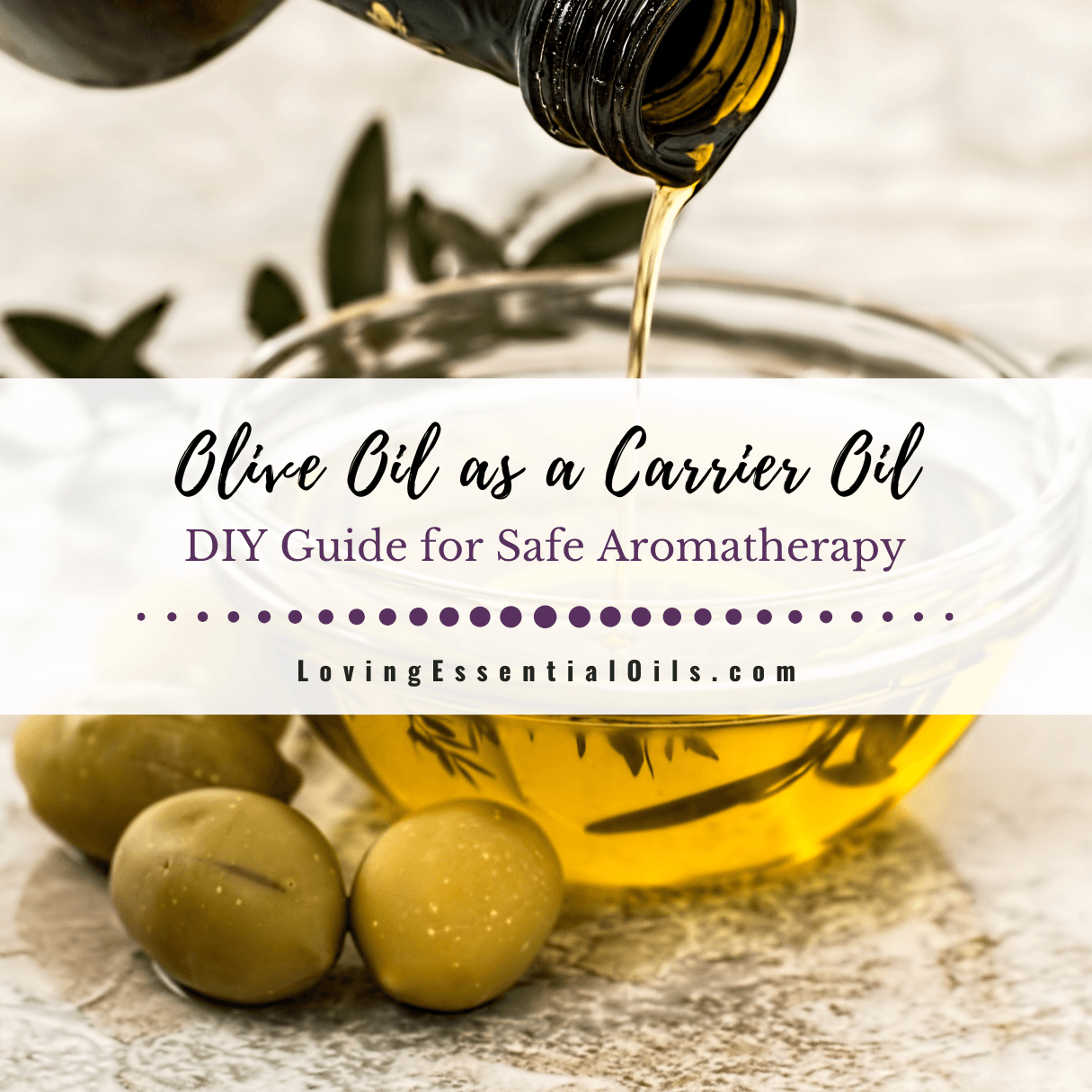
Using olive oil as a carrier oil works well for massage oils, salves, rough spots like elbows and heels, and pre-wash hair oils. It dilutes essential oils just like any other carrier, it’s affordable, and you probably already have a bottle in your pantry. Because a 2013 study found that daily olive oil can weaken the skin’s barrier, it’s best for occasional use, and sunflower or jojoba is gentler for everyday skin care. Its stronger scent and heavier feel also mean it isn’t my pick for faces or delicate floral blends.
Below I’ll share what olive oil does well, where a lighter carrier is the better choice, how to dilute your oils in it, and three easy recipes. For the bigger picture, see my full list of carrier oils. Jump to the recipes.
What Makes Olive Oil a Good Carrier Oil?
Olive oil is pressed from the fruit of the olive tree (Olea europaea). It’s rich in oleic acid, a fatty acid that gives it a smooth, cushiony feel on the skin, and extra virgin olive oil also contains vitamin E and plant polyphenols.
When you use olive oil as a carrier oil, its job is simple: it spreads your essential oils out so they’re gentle enough for your skin. Olive oil does that well, and because it’s already in most kitchens, it’s an easy way to try your first blend without buying anything new. If you’re still getting the basics down, read my quick guide to carrier oil vs essential oil.
Olive Oil Quick Facts
| Olive oil | Details |
|---|---|
| Botanical name | Olea europaea |
| Part used | Fruit, pressed |
| Feel | Thick, rich, and slow to absorb |
| Scent | Fruity and grassy (extra virgin), milder when refined |
| Comedogenic rating | 2 |
| Shelf life | Up to about 2 years unopened; use within a few months of opening |
| Nut allergy | Comes from a fruit, not a tree nut |
| Best for | Occasional massage oils, salves, rough elbows, knees, and feet, pre-wash hair oils |
The Pros and Cons of Olive Oil as a Carrier
Yes, you can use olive oil as a carrier oil, with a few trade-offs worth knowing.
What I Like About It
- Good glide for massage: it absorbs slowly, so it stays slippery long enough for a proper shoulder or foot rub.
- Budget-friendly: it’s one of the most affordable carriers, which is handy for bigger batches.
- Easy to find: any grocery store has it, so you can start blending today.
What to Keep in Mind
- Noticeable scent: extra virgin olive oil smells fruity and grassy, and it can cover up light florals and citrus. It pairs best with stronger oils like lavender, rosemary, cedarwood, frankincense, and ginger.
- Heavy, greasy feel: it leaves a film on the skin, which some people don’t love, especially on hot days.
- Not ideal for faces: with a comedogenic rating of 2 and a heavy texture, it’s better kept to the body if you’re prone to breakouts.
- Thick in rollers: it pours slowly and can feel sticky in a roller bottle, so I use it more for jars and massage bottles.
- Shorter life once opened: an open bottle is best used within a few months, so it’s not the carrier for a blend you’ll use slowly.
Is Olive Oil Good for Dry Skin? An Honest Note
Olive oil does make rough, dry patches feel softer for a while. But I want to share something I think more people should know. A 2013 study in Pediatric Dermatology found that applying olive oil to the forearms twice a day for four weeks weakened the skin’s outer barrier and caused mild redness. Sunflower seed oil, tested at the same time, didn’t, and it improved hydration.
Here’s how I use that information:
- Olive oil is fine for an occasional massage, salves, rinse-off hair oils, and now-and-then use on rough spots.
- For an everyday moisturizer or regular massage, or if you have eczema-prone or very sensitive skin, I choose jojoba or sunflower oil instead.
- I don’t use olive oil for baby massage.
For gentler options, see my best carrier oils for massage, my best essential oils for dry skin, and my non-comedogenic carrier oils.
How to Dilute Essential Oils in Olive Oil
Diluting essential oils with olive oil as a carrier oil works just like any other carrier. Count every essential oil in the blend toward the total.
| Dilution | Per 1 Tbsp (15 ml) | Per 1 oz (30 ml) | Who it’s for |
|---|---|---|---|
| 0.5% | 1 to 2 drops | 3 drops | Kids 2 to 4, six starter oils only, after checking with your pediatrician |
| 0.5 to 1% | 2 to 3 drops | 3 to 6 drops | Kids 5 to 11, sensitive skin, older adults, pregnancy after 16 weeks |
| 1 to 2% | 3 to 6 drops | 6 to 12 drops | Full-body massage and body oils, ages 12+ |
| 2 to 3% | 6 to 9 drops | 12 to 18 drops | Smaller areas like feet or shoulders, ages 12+ |
| Up to 5% | Up to 15 drops | Up to 30 drops | Ages 15+ only, short-term, on a small spot |
A few oils have lower limits of their own, like clove bud at 0.5% and ylang ylang at 0.8%. My dilution chart and calculator walks through the details.
Easy Recipes with Olive Oil
These recipes mix olive oil and essential oils for the body and hair, where olive oil works best.
Soft Elbows, Knees, and Feet Body Oil
Body oil · Ages 12+ · 1.5%
A soft, warm floral oil for rough elbows, knees, and heels after a shower.
- 6 drops lavender (Lavandula angustifolia)
- 3 drops frankincense (Boswellia carterii)
- 2 Tbsp (30 ml) extra virgin olive oil
Directions: Mix everything in a small amber glass jar or bottle. After a shower, massage a little into rough elbows, knees, and heels while your skin is still slightly damp, and give it a few minutes to sink in before getting dressed. Learn more in my frankincense essential oil guide and uses for lavender essential oil.
Little Soft Feet Oil
Body oil · Ages 5+ · about 0.7%
The same soft scent, made gentle for kids’ rough heels and knees.
- 3 drops lavender (Lavandula angustifolia)
- 1 drop frankincense (Boswellia carterii)
- 2 Tbsp (30 ml) extra virgin olive oil
Directions: Make it the same way as the grown-up oil, and rub a little into heels and knees yourself.
Note: Label it with your child’s name and the dilution.
Tired Muscle Massage Oil
Massage oil · Ages 12+ · 2%
A fresh, warming olive oil massage oil for tired shoulders, calves, or lower back after a long day.
- 5 drops rosemary (Salvia rosmarinus, formerly Rosmarinus officinalis, ct. cineole)
- 4 drops ginger (Zingiber officinale)
- 3 drops peppermint (Mentha × piperita)
- 2 Tbsp (30 ml) extra virgin olive oil
Directions: Combine in a glass bottle and shake gently. Massage into tired shoulders, calves, or lower back with slow, firm strokes. Keep it away from your face, and wash your hands afterward. For more ideas, see my warming ginger massage oil and 22 DIY aromatherapy massage oils.
Pre-Wash Hair and Scalp Oil
Scalp oil · Ages 12+ · about 1.3%
A soft, woody floral oil to comb through before you shampoo.
- 4 drops cedarwood Atlas (Cedrus atlantica) or Virginian (Juniperus virginiana)
- 4 drops lavender (Lavandula angustifolia)
- 2 Tbsp (30 ml) extra virgin olive oil
Directions: Warm the olive oil slightly by setting the jar in a bowl of warm (not hot) water, then stir in the essential oils. Massage into your scalp and comb through the lengths of your hair, then wrap your hair in a towel for about 30 minutes. Shampoo twice to wash it out. If your hair is fine, mix the olive oil half and half with jojoba so it rinses out more easily. See my DIY essential oil hair mask and scalp oil for more.
A Few Safety Basics
• Keep essential oils away from babies under 2, including diffusing in a room they’re in.
• Always dilute oils before they touch skin, and patch test a new blend on your inner forearm for 24 to 48 hours.
• Check the age on each recipe. Kids 2 to 4 use only six starter oils at 0.5%, after checking with your pediatrician. Kids 5 to 11 stay at 0.5 to 1%.
• If you’re pregnant, check with your doctor or midwife first. For the first 16 weeks I use only six oils, and only in a diffuser or inhaler: lavender, sweet orange, lemon, ginger, cedarwood (Virginian), and frankincense. After that, skin blends stay at 0.5 to 1%.
• Never put oils on pets, and diffuse with a door open so they can leave. Cats are especially sensitive; see my essential oil pet safety guide.
• Never swallow essential oils, even mixed into olive oil. If someone does, call Poison Control at 1-800-222-1222.
How to Choose Olive Oil for Aromatherapy
For the best results with olive oil as a carrier oil, the grade you buy matters.
- Extra virgin olive oil: the least processed grade, with the most vitamin E and polyphenols. It also has the strongest scent.
- Refined or “light” olive oil: milder in scent, which can be nice for blends, though it has fewer of olive oil’s natural compounds.
- Skip olive pomace oil: it’s extracted from leftover pulp, often with solvents, and isn’t what you want on your skin.
- Check the date: look for a harvest or best-by date, and buy a bottle you’ll use within a few months of opening (Olive Oil Times).
Store it in a dark glass bottle away from the stove and sunny windows. If it starts to smell like crayons or old nuts, it has gone rancid, and it’s time to replace it. Olive oil, like any carrier oil, doesn’t go in a diffuser. My carrier oil shelf life and storage guide has more tips.
Olive Oil vs Other Carrier Oils
Here’s how olive oil as a carrier oil compares with other popular carriers.
| Carrier oil | Feel | Scent | Shelf life once opened | Best for |
|---|---|---|---|---|
| Olive | Thick, slow to absorb | Noticeable | A few months | Occasional massage, salves, hair oils |
| Sunflower | Smooth, light | Mild | High-oleic lasts longest | Regular massage, dry or sensitive skin, nut allergies |
| Jojoba | Silky, medium absorption | Very faint | 2 years or more | Face, rollers, daily use |
| Fractionated coconut | Thin, non-greasy | None | 2 years or more | Rollers, delicate blends |
| Sweet almond | Smooth, medium | Very faint | 1 to 2 years | Massage, body oils (not with nut allergies) |
Compare more in my best carrier oils for massage and 5 best carrier oils for essential oils.
Keep Exploring
- List of carrier oils: 25 best carrier oils
- Everything you need to know about carrier oils
- Avocado oil as a carrier oil
- Fractionated coconut oil vs jojoba for rollers
- Carrier oil shelf life and storage
Ready to start blending? My Aromatherapy Supply Kits include the bottles and supplies to make your first blends, and you can grab one of my free essential oil guides.
Essential Oil Guide for Beginners - Getting Started
$ 5.99
Beginner's Essential Oil Guide - Download/Printable Learn how to safely and effectively make essential oils a part of your everyday life. Everything you need to know about essential oils. If you have ever been around anyone who loves using essential… Read More