
Table of Contents
- Photosensitive Essential Oils: Quick List
- What is Essential Oil Photosensitization?
- Signs of a Phototoxic Reaction
- Photosensitive Essential Oils
- Angelica Root (Angelica archangelica)
- Bergamot (Citrus bergamia)
- Cumin (Cuminum cyminum)
- Grapefruit (Citrus paradisi)
- Laurel Leaf Absolute (Laurus nobilis)
- Lemon, cold-pressed (Citrus limon)
- Lime, cold-pressed (Citrus aurantifolia)
- Bitter Orange, cold-pressed (Citrus aurantium)
- Mandarin Leaf (Citrus reticulata)
- Fig Leaf Absolute (Ficus carica)
- Rue Essential Oil (Ruta graveolens)
- How to Avoid Photosensitization
- Sun Safe Citrus Essential Oils
- Featured DIY Recipe
- Free Cheat Sheet: Sun Safety and Essential Oils Guide
- FAQs
Learn which essential oils are photosensitive and how to keep your skin safe when it's sunny outside. Don't let a fun day in the sun end with an essential oil burn.
Some essential oils can make your skin extra sensitive to UV rays from the sun or tanning beds. When these oils are applied to the skin and that skin is then exposed to UV light, it can cause a painful reaction. Knowing which oils to watch for is the best way to avoid it.
This post contains affiliate links. If you buy through them, I may earn a small commission at no extra cost to you.
Photosensitive Essential Oils: Quick List
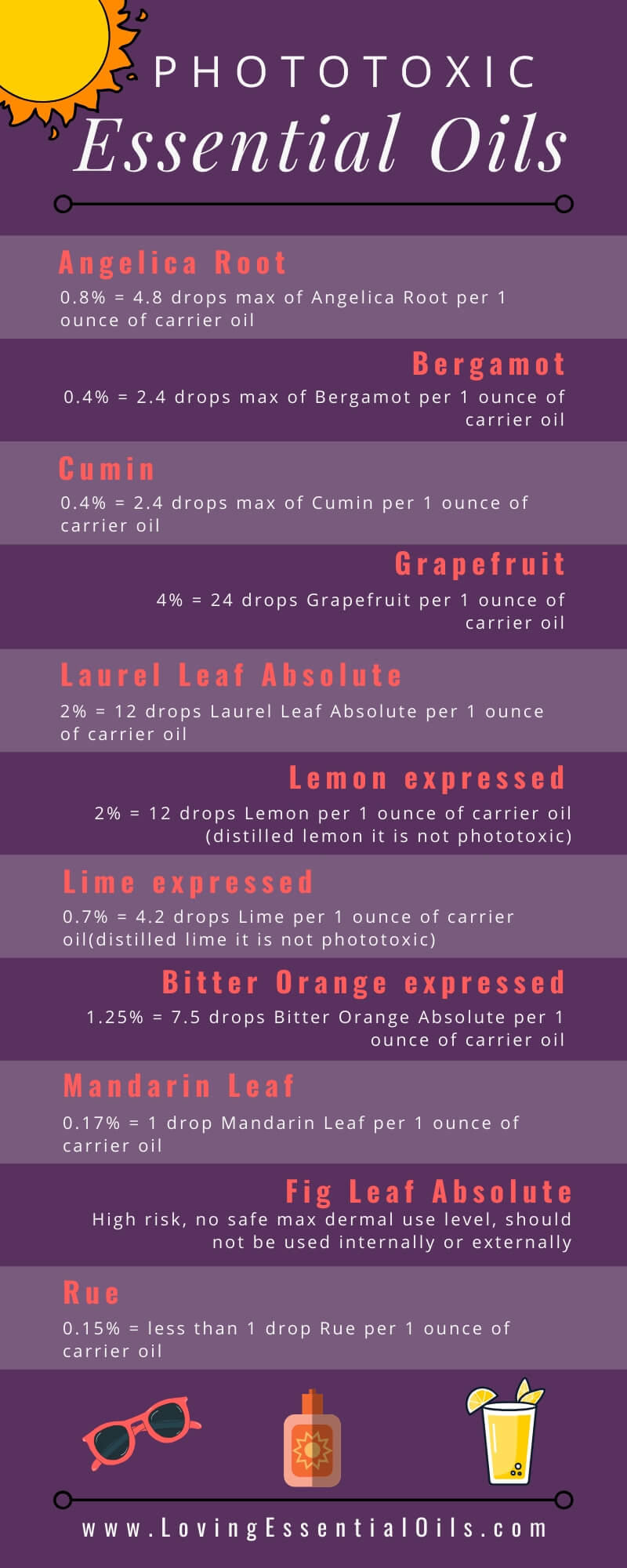
These are the phototoxic essential oils to watch for, with the maximum safe dilution if the skin will be in the sun within 12 hours. Levels are from Essential Oil Safety (2nd Ed) by Tisserand & Young.
| Essential oil | Max on sun-exposed skin | Drops per 1 oz (30 ml) carrier |
| Angelica Root (Angelica archangelica) | 0.8% | about 5 drops |
| Bergamot (cold-pressed) (Citrus bergamia) | 0.4% | about 2 drops |
| Cumin (Cuminum cyminum) | 0.4% | about 2 drops |
| Grapefruit (cold-pressed) (Citrus paradisi) | 4% | about 24 drops |
| Laurel Leaf Absolute (Laurus nobilis) | 2% | about 12 drops |
| Lemon (cold-pressed) (Citrus limon) | 2% | about 12 drops |
| Lime (cold-pressed) (Citrus aurantifolia) | 0.7% | about 4 drops |
| Bitter Orange (cold-pressed) (Citrus aurantium) | 1.25% | about 7 drops |
| Mandarin Leaf (Citrus reticulata) | 0.17% | about 1 drop |
| Rue (Ruta graveolens) | 0.15% | less than 1 drop |
| Fig Leaf Absolute (Ficus carica) | Do not use | None |
Sun-safe swaps: sweet orange, mandarin (peel), tangerine, steam distilled lemon, steam distilled lime and Bergamot FCF. Download the free printable cheat sheet.
What is Essential Oil Photosensitization?
Essential oil photosensitization (also called phototoxicity) happens when certain natural compounds in an oil react with UV light on the skin.
This reaction is also known as photocontact dermatitis: “a reaction to a substance applied to the skin that occurs only in the presence of UV light in the UVA range, and it may be either phototoxic or photo allergenic.” - Essential Oil Safety (2nd Ed) by Tisserand & Young, pg. 84
The compounds responsible are called furanocoumarins. They are found mostly in citrus oils that are cold-pressed from the peel, which is why steam distilled versions of the same oils are usually sun safe.
To learn more about how to use essential oils safely, see my essential oil safety tips.
Signs of a Phototoxic Reaction
A phototoxic reaction can show up within hours of sun exposure. The risk goes up if you use several photosensitizing oils in the same blend.
- An exaggerated sunburn, sometimes with blisters (the most common reaction)
- Strong reddening of the skin
- Swelling and dark patches of skin
- Pigment changes that can take months to fade, and sometimes don't fully go away
"Certain drugs, such as tetracycline, increase the photosensitivity of the skin, thus increasing the harmful effects of photosensitizing essential oils under the necessary conditions." - NAHA
Photosensitive Essential Oils
Here are the phototoxic oils to avoid applying to your skin before sun exposure, or to keep at or below the safe level listed. When properly diluted, you can use these oils on skin that will be in the sun without a reaction.
You can read more in Essential Oil Safety (2nd Ed) by Tisserand & Young, pages 84 to 88. It is a very technical book, more of a textbook than an easy read, but if you love the science you will enjoy it.
Angelica Root (Angelica archangelica)
Angelica root has an earthy, woody, slightly spicy scent. The root oil contains furanocoumarins, so keep it well diluted on any skin that will see the sun.
- Safe Level: 0.8%, about 4.8 drops max per 1 ounce of carrier oil
Bergamot (Citrus bergamia)
Bergamot has a sweet, fruity, citrusy scent and is one of the most phototoxic oils commonly used. Regular cold-pressed bergamot contains bergapten, the compound responsible. Choose Bergamot FCF (see below) for skin products.
- Safe Level: 0.4%, about 2.4 drops max per 1 ounce of carrier oil
Cumin (Cuminum cyminum)
Cumin has a warm, earthy, spicy aroma. It is phototoxic and can also irritate skin, so it is best used in a diffuser or kept at very low dilutions.
- Safe Level: 0.4%, about 2.4 drops max per 1 ounce of carrier oil
Grapefruit (Citrus paradisi)
Grapefruit has a bright, invigorating scent. Cold-pressed grapefruit is only mildly phototoxic, so it has a higher safe level than most citrus oils.
- Safe Level: 4%, about 24 drops max per 1 ounce of carrier oil
Laurel Leaf Absolute (Laurus nobilis)
Laurel leaf essential oil is different from laurel leaf absolute, and the essential oil is the type most commonly sold. Only the absolute is phototoxic. Learn more about the difference between essential oils and absolutes.
- Safe Level: 2%, about 12 drops max per 1 ounce of carrier oil
Lemon, cold-pressed (Citrus limon)
Lemon has a fresh, cheerful scent that many people love in skincare. Most lemon oil is cold-pressed from the peel, which makes it phototoxic.
- Safe Level: 2%, about 12 drops max per 1 ounce of carrier oil. Steam distilled lemon is not phototoxic.
Lime, cold-pressed (Citrus aurantifolia)
Cold-pressed lime is one of the stronger phototoxic citrus oils. Read all about sun-safe lime essential oil that is steam distilled.
- Safe Level: 0.7%, about 4.2 drops max per 1 ounce of carrier oil. Steam distilled lime is not phototoxic.
Bitter Orange, cold-pressed (Citrus aurantium)
Bitter orange comes from a different tree than sweet orange and is phototoxic when cold-pressed. Don't confuse the two: sweet orange essential oil (Citrus sinensis) is sun safe and the one I prefer to use.
- Safe Level: 1.25%, about 7.5 drops max per 1 ounce of carrier oil
Mandarin Leaf (Citrus reticulata)
Mandarin leaf oil is uncommon and different from regular mandarin oil. When buying mandarin, check that it is cold-pressed from the peel, not the leaf. Mandarin peel oil is considered sun safe.
- Safe Level: 0.17%, about 1 drop max per 1 ounce of carrier oil
Fig Leaf Absolute (Ficus carica)
Fig leaf absolute should not be used on the skin at all because it is extremely phototoxic and sensitizing.
- Safe Level: High risk, no safe maximum dermal use level
Rue Essential Oil (Ruta graveolens)
Rue is not recommended for aromatherapy. Besides being phototoxic, it is toxic if swallowed, irritates skin and should never be used during pregnancy.
- Safe Level: 0.15%, less than 1 drop per 1 ounce of carrier oil
A few more essential oils are possibly phototoxic, according to Tisserand & Young:
- Clementine
- Combava Fruit Oil
- Skimmia Oil
- Angelica Root Absolute
- Angelica Root CO2 extract
- Celery Leaf Oil
- Celery Seed Absolute
- Cumin Seed Absolute
- Cumin Seed CO2 extract
- Khella Oil
- Lovage Leaf Oil
- Parsnip Oil
How to Avoid Photosensitization
Here are six simple ways to keep enjoying these oils safely.
1. Use Aromatically Instead
The simplest way to avoid a reaction is to not put phototoxic oils on your skin. Enjoy them in a diffuser, an aromatherapy inhaler or an essential oil diffuser necklace instead.
2. Dilute Properly
Photosensitive essential oils can still be used on skin that will see UV light, as long as you stay at or below the safe levels in the chart above.
3. Enjoy in Wash-Off Recipes
It is fine to use these oils in hand soaps, body washes and other recipes that are rinsed off. This does not include a long soak in the bath, since your skin is in contact with the oils for longer.
“There is generally no phototoxic risk if the oils are used in a product that is either not applied to the body or is washed off the skin, such as shampoo, bath preparation, or soap. However, essential oils can adhere to the skin if used in a sauna or steam inhalation.” - Essential Oil Safety (2nd Ed) by Tisserand & Young, pg. 88
4. Avoid the Sun
Stay out of the sun and tanning beds for 12 to 18 hours after applying a phototoxic oil to exposed skin. Have a favorite skincare recipe with grapefruit or lemon? Apply it in the evening.
5. Cover Up
Covering skin where you applied photosensitive oils can prevent a reaction. Just make sure the fabric truly blocks the sun, since a thin T-shirt may not be enough.
"There is no risk if the skin to which the oils are applied is covered in such a way as to prevent UV rays from reaching them." - Essential Oil Safety by Tisserand & Young, pg. 88
6. Use Essential Oils that are Sun Safe
Many oils can stand in for phototoxic ones. Choose an oil with a similar aroma that is not on the phototoxic list.
Cold-pressed lime and lemon are phototoxic, but steam distilled versions lack the compounds that cause sun sensitivity, so they are not phototoxic.
"The furanocoumarins are relatively non-volatile molecules and are generally found in expressed (cold-pressed) citrus fruit oils, but not in distilled citrus fruit oils." - Essential Oil Safety (2nd Ed) by Tisserand & Young, pg. 85
This is great news! You can still enjoy lime and lemon on your skin, worry-free, as long as they are steam distilled. Plant Therapy offers both:
- Steam Distilled Lime Essential Oil from Plant Therapy
- Steam Distilled Lemon Essential Oil from Plant Therapy
Bergamot FCF Essential Oil
You can buy bergamot with the bergapten (a furanocoumarin) removed. It is called Bergamot FCF, which stands for furanocoumarin free.
Essential Oil Guide for Beginners - Getting Started
$ 5.99
Beginner's Essential Oil Guide - Download/Printable Learn how to safely and effectively make essential oils a part of your everyday life. Everything you need to know about essential oils. If you have ever been around anyone who loves using essential… Read More
Sun Safe Citrus Essential Oils
Many people think all citrus oils are phototoxic, but that isn't true. These citrus oils are safe to use on skin before going in the sun:
- Bergamot FCF, bergapten-free (Citrus bergamia)
- Steam Distilled Lemon (Citrus limon)
- Steam Distilled Lime (Citrus aurantifolia)
- Mandarin, from the peel (Citrus reticulata)
- Sweet Orange (Citrus sinensis)
- Tangerine (Citrus reticulata)

Featured DIY Recipe
Sun Safe Citrus Blend
Here is a cheerful citrus body oil made with only sun-safe essential oils. The trio is uplifting and a perfect scent for a warm, sunny day.
- 10 drops Sweet Orange essential oil
- 8 drops Tangerine essential oil
- 6 drops Steam Distilled Lime essential oil
- 2 oz (60 ml) Jojoba Oil
- 2 oz Pump Bottle or Dropper Bottle
Directions: Add the essential oils to the pump bottle and fill the rest of the bottle with jojoba. Shake to blend. To use, pump a small amount into your hand and rub onto skin. This is a 2% dilution. Keep citrus oils fresh, since old, oxidized citrus oils are more likely to irritate skin.
Free Cheat Sheet: Sun Safety and Essential Oils Guide
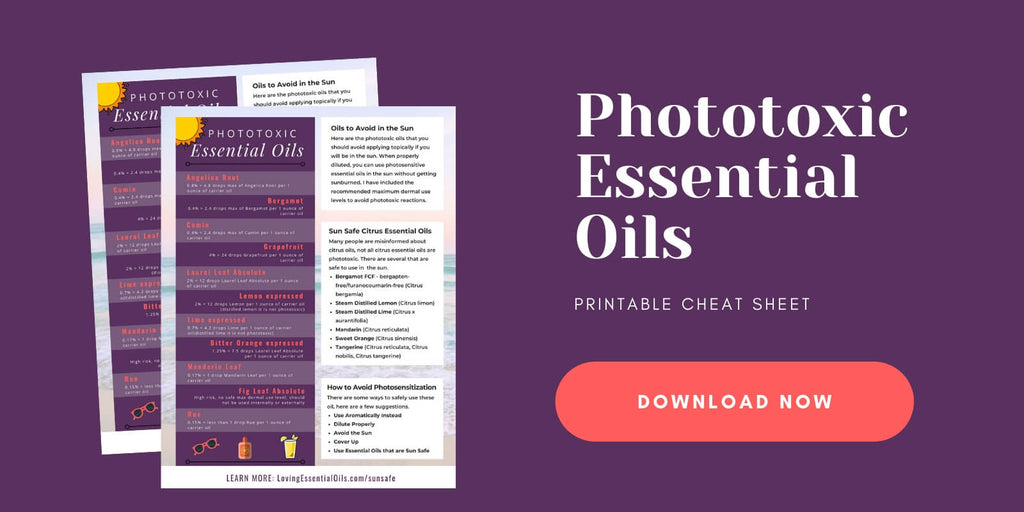
Keep this quick reference guide handy all summer long. Get the free printable Photosensitive Essential Oils cheat sheet. No email required, just please share this post so your friends and family can stay sun safe too.
Share on Pinterest
More Essential Oil Safety Posts
- 7 Must-Know Essential Oil Safety Tips
- How to Do an Essential Oil Skin Patch Test
- Do Essential Oils Expire?